On show season, taking things apart, and the invisible decisions inside something handmade.
Yesterday, I took apart a necklace that was almost finished.
There was nothing obviously wrong with it. The stones were beautiful. The color worked. It lay the way it was supposed to.
But every time I looked at it, one stone interrupted the rhythm.
It was lovely on its own. Inside the strand, though, it kept pulling my eye toward it. I tried moving it. I turned the necklace around. I left it on the table and came back later, hoping that perhaps I was simply looking at it too closely.
Eventually, I knew.
The necklace had to come apart.
This is one of the parts of making that people rarely see.
By the time a piece of handmade gemstone jewelry arrives at a show, it looks resolved. The stones have found their places. The clasp works. The proportions feel right. It can be difficult to imagine all the choosing, changing, removing, restringing, and beginning again that came before it.
This month is especially busy with shows, and the studio has taken on a different rhythm.
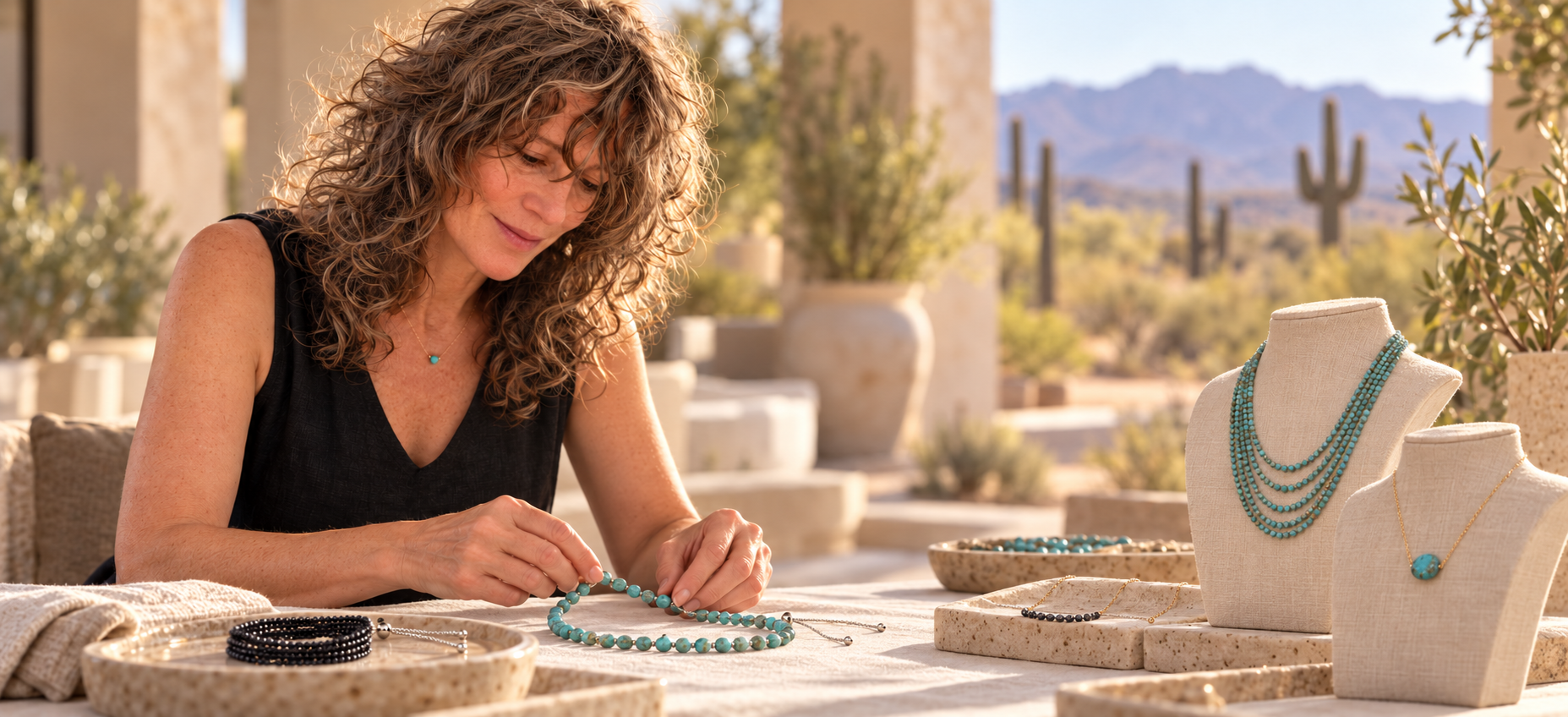
There are stones spread across the table, pieces waiting for one final detail, and small groups of necklaces beginning to gather for the road. There are lists beside lists: what needs to be finished, what needs to be packed, what I want to bring, and what I am still hoping to make if there is time.
The work becomes both expansive and very small.
I am thinking about an entire show while looking closely at the space between two stones.
Making Is Mostly Choosing
People often ask how long it takes to make a necklace.
I never quite know how to answer.
Do I count only the time it takes to string and knot it? Or do I count the hours spent choosing the stones, laying them out, changing their order, and waiting for the missing piece to arrive?
Do I count the time I spend walking past a necklace on the table, looking at it from across the room because something about it still feels unsettled?
Sometimes the actual making is the shortest part.
The hands matter, of course. They learn how tightly to pull a knot, how a clasp should sit, and how much space to leave between one element and the next.
But there is also the eye.
There is instinct.
There is the willingness to notice when something is almost right, and the patience to stay with it until it becomes whole.
Sometimes two stones are nearly identical, but one carries a slightly different temperature. Sometimes a color that looked beautiful in the tray becomes too insistent once it joins a strand. A clasp can change the way a piece falls. One stone can alter the balance of everything around it.
None of these decisions are dramatic.
The person who eventually wears the piece may never know about them.
But I believe they can feel the result.
The Discipline of Taking Something Apart
Taking apart finished work can feel unreasonable, especially during a busy month.
There are deadlines. There are shows to prepare for. There is always another piece waiting to be made.
The practical voice says, It is fine.
And sometimes fine really is fine. Not every tiny variation needs to become a problem.
But there are other times when I know I will continue to see the thing that is not quite right. Once I have noticed it, I cannot ask someone else to carry it simply because I was in a hurry.
So I begin again.
I remove the clasp.
I loosen the knots.
I return the stones to the table.
It is not perfection I am after. Natural stones were never meant to be identical. Their variations, inclusions, markings, and irregularities are part of what makes them beautiful.
I do not want to erase their character.
I am listening for the place where those differences belong together.
A piece can contain contrast and still feel balanced. It can be colorful without becoming loud. It can hold movement without losing its center.
Finding that point is the work.
There is nothing particularly glamorous about this part. There is no finished necklace to photograph. There is only a loosened clasp, a length of thread, and a small gathering of stones waiting for me to make another decision.
I think I may love this part, too.
Not always while I am doing it. But afterward, when the piece finally settles into itself and I can no longer imagine it arranged any other way.
What Comes With Me
Preparing for shows always reminds me how much of my life happens before anyone walks into the room.
People see the finished necklaces arranged together. They pick up a bracelet, feel the weight of a stone, or try on something they might never have chosen from a photograph.
What they do not see are the evenings when one last piece is still on the table.
They do not see the strand I made twice.
They do not see the stones I loved but decided not to use.
They do not see how many small decisions had to agree with one another before a piece could leave the studio.
I do not think they need to.
The purpose of all that attention is not to make the work feel complicated. It is to allow the finished piece to feel natural, as though the stones had always belonged in that particular order.
The work should not carry the strain of its making.
It should simply feel ready.
Attention Made Visible
There is a great deal of conversation about handmade objects, but what matters to me is not only that something passed through a person’s hands.
It is that someone was paying attention.
The American Craft Council describes craft through ideas of deliberateness, accumulated skill, and an ongoing relationship with material and process. I understand that. The longer I make jewelry, the more the work feels like a conversation between what I intended and what the stones are actually asking me to notice. American Craft Council
Someone noticed the color that was slightly wrong.
Someone cared about how the piece moved against the body.
Someone removed the stone that was beautiful but did not belong.
Someone made a decision that would never appear on a label or be explained to the person who eventually took the piece home.
That attention remains inside the object.
Perhaps that is what we recognize when something handmade feels different. We may not know how many times it was changed or how long it waited on the table.
We only know that it feels considered.
The necklace I took apart yesterday is still waiting for me in the studio.
The stone that interrupted its rhythm has been removed. The others are spread across the table again, ready to find their new places.
There is more work to do before I leave for the next show.
But this is the work.
Not simply finishing the necklace.
Listening until I know it is finished.