Land Met With Presence
Some places ask more of us.
Not in a demanding way, but in a quiet one.
They ask us to slow down.
To soften.
To look again.
To notice what we might have missed if we were only trying to get somewhere.
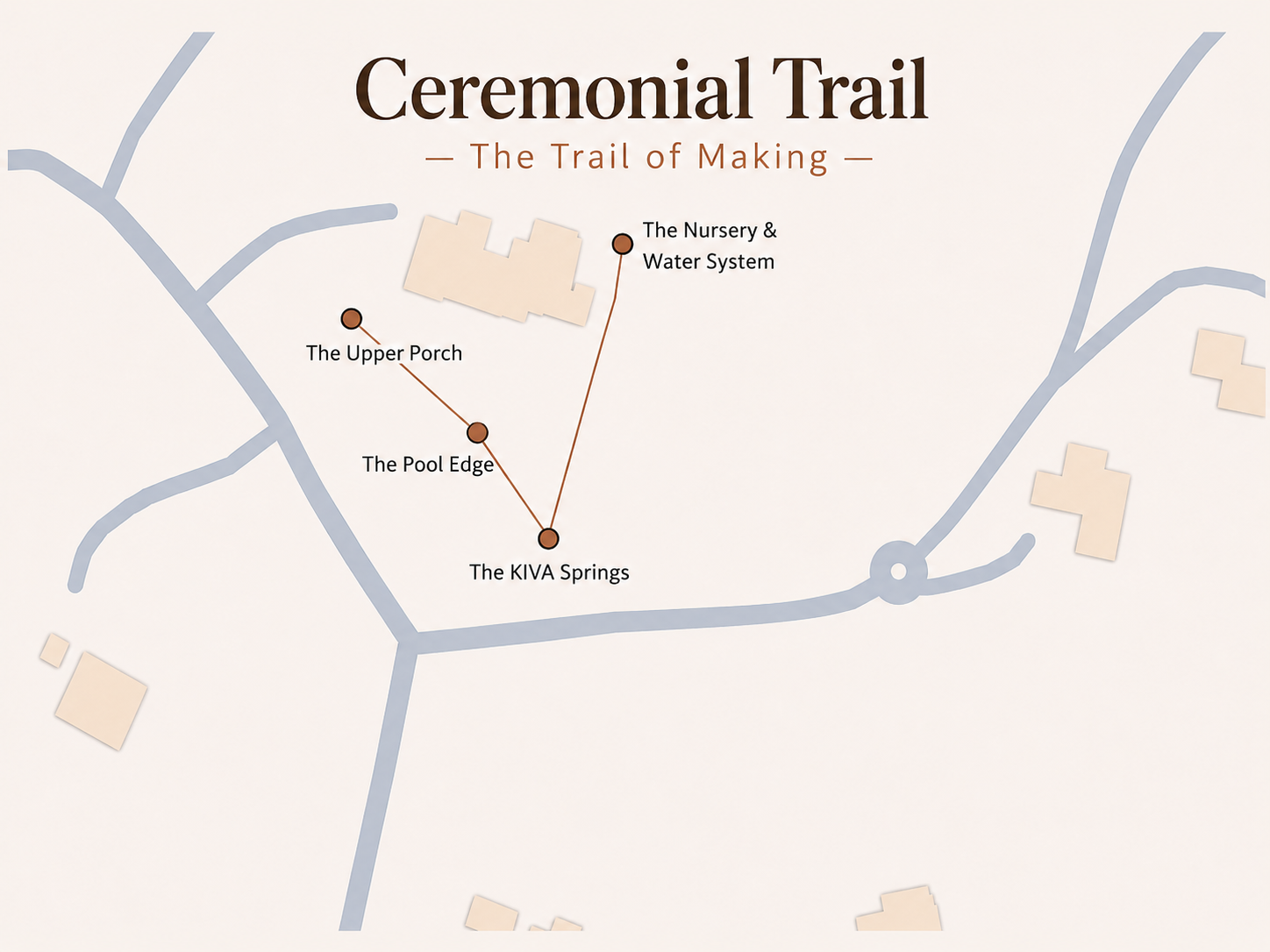
I have been thinking about that a great deal lately as I build Ceremonial Trails™.
At its heart, this work begins with a simple belief I keep returning to:
Land is not a backdrop.
A path is not only a way through.
A place can be met, not just passed.
And when it is met with presence, something changes.
The pace changes first.
Attention returns.
The mind, which may have been racing ahead, begins to arrive where the feet already are.
I love that moment.
That threshold where movement becomes something more than movement. Where a walk becomes a kind of listening. Where the world around us begins to feel less like scenery and more like relationship.
That is the spirit behind Ceremonial Trails™.
This work has gathered so many of the things I care about most: land, atmosphere, movement, pacing, sound, beauty, attention, memory, and the feeling of helping someone enter a place more fully.
A More Place-Based Hospitality Experience
I do not think of these trails as programming layered onto a property.
I think of them as a way of helping someone feel the place they are already in more deeply.
A path shaped through atmosphere, reflection, beauty, pacing, presence, and return.
A quieter way of guiding someone into relationship with a landscape, a garden, a property, or a stretch of land that already holds its own character.
Some places already ask us to notice.
A path at dawn.
A bench under trees.
A turn in the trail where the light changes.
A water’s edge.
A quiet overlook.
The long exhale that comes when you step outside and the world feels wider than it did indoors.
Those moments matter to me.
Not because they are dramatic. Often they are not.
But because they open something.
They interrupt the momentum of passing through. They remind us that a place can shape our experience when we are willing to meet it differently.
I think many of us are hungry for that now.
Not only more beauty, though beauty matters.
Not simply more programming.
But a more conscious relationship with where we are.
A feeling that the places we move through have character, history, rhythm and something worth noticing.
That kind of experience does not need to be loud.
It can be discreet.
Editorial.
Lightly held.
A marker on a path.
A short piece of audio.
A prompt that asks you to observe, remember, pause, listen, look again.
Sometimes that is enough.
Sometimes one small invitation changes the quality of a whole walk.
Ceremonial Trails™ as a Guided Walking Experience
That is part of why I love the idea of a trail.
It does not force. It accompanies.
It allows someone to encounter meaning at their own rhythm, to be guided without being managed, to move through a place quietly enough for their own experience to surface.
That feels very true to everything I want The Art of Ceremony Experience to be.
I am not interested in overwhelming a place.
I am interested in revealing what is already there:
the mood of the land,
the logic of the path,
the emotional architecture of arrival, transition, pause, discovery, and return.
Every meaningful place already has its own pace.
Some invite reverence.
Some ask for stillness.
Some wake up the senses.
Some offer a view that rearranges something inside you before you have words for it.
Ceremonial Trails™ begins by listening for that.
Not imposing a script.
Not layering something generic on top.
But asking:
What is this place already asking us to notice?
And how might we help someone notice it more fully?
To me, that is ceremony.
Not performance.
Not spectacle.
Not something reserved for rare or dramatic moments.
But a way of meeting life with more care.
When the Location Determines the Ceremony
Every Ceremonial Trail™ begins with the place itself.
Where does the path open?
Where does it narrow?
Where does the light change?
What can be heard here?
Where do people naturally stop?
What happens at this point in the morning—and what changes at dusk?
Those details matter because a trail created for one place should not be interchangeable with a trail created for another.
The location determines the ceremony.
A desert trail should feel like the desert.
A garden should be allowed to remain a garden.
A path beside water carries a different rhythm than one moving through stone.
The experience begins by paying attention to those differences rather than smoothing them away.
This is what makes a place-based experience feel native to its surroundings rather than added afterward.
Creating Memory Through Place
A trail can hold a first walk after arrival.
A quiet stop before a spa treatment.
A pause beneath a tree.
A final overlook at sunset.
Even a brief encounter can change the feeling of a stay.
It can help someone remember where they are.
It can invite them into a deeper sense of place.
And it can create memory not only through what they saw, but through what they noticed while moving through it.
This is what interests me about hospitality experiences built around place.
A beautiful property already contains so much of the experience.
The landscape is already speaking.
The architecture is already directing movement.
Light is already changing throughout the day.
Paths are already creating arrivals, pauses and transitions.
Sometimes the work is simply to notice those things carefully enough to create an invitation around them.
Meeting the Place
Ceremonial Trails™ is my way of creating a more place-based hospitality experience—one that helps guests move through land, landscape and property with greater attention and meaning.
Each trail is shaped specifically for its location, with self-guided moments woven into the existing environment rather than imposed upon it.
Because some places deserve more than to be admired.
They deserve to be met.
And when we meet a place with presence, we may discover that it has been offering us something all along.